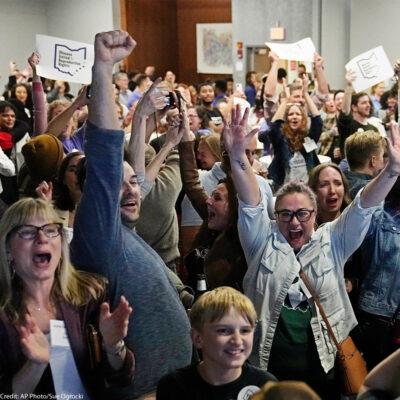
We’re Winning Big at the Polls
November 9, 2023
On Tuesday, people across the country took to the polls and made one thing crystal clear: abortion rights matter to voters.
In Ohio, voters passed an amendment to enshrine abortion rights in the state constitution, making it the seventh state to protect abortion access through the ballot box. In Virginia, voters elected a full pro-abortion rights majority in their state General Assembly, and in Pennsylvania, voters maintained a pro-abortion majority in their state supreme court.
As we look to 2024, abortion rights will continue to be on the ballot, meaning that anti-abortion opponents may continue to chip away at voting rights as a mechanism to block the will of voters, using tactics like racial gerrymandering and voter intimidation. All voters deserve an equal opportunity to exercise their rights and participate in democracy.
Today, we’ll get an election results update from Jessica Arons, senior policy counsel at the ºìÐÓÊÓƵ, who has been working to secure victories for reproductive freedom at the ballot box. Then, we’ll speak with Sophia Lin Lakin, director of the ºìÐÓÊÓƵ's Voting Rights Project, to talk about how her team is using a recent voting rights victory at the Supreme Court to fight battles all across the country.
In this episode
Kendall Ciesemier



Listen to this episode on
This Episode Covers the Following Issues
Related Content
-
Press ReleaseSep 2026

Voting Rights
Federal Court Blocks U.s. Postal Service From Interfering With Mail Ballots In November Election . Explore Press Release.Federal Court Blocks U.S. Postal Service from Interfering with Mail Ballots in November ElectionÂ
Preliminary injunction bars USPS from enforcing a rule that would have made voter disenfranchisement “practically inevitableâ€� BOSTON – A federal district court today issued a preliminary injunction blocking the U.S. Postal Service (USPS) from enforcing key parts of a rule that would have operationalized President Trump’s March 31 executive order restricting mail voting. Under the rule, the postal service would have refused to deliver mail ballots to certain voters. The court found that the rule was likely unconstitutional and unlawful — and that enforcing it would make voter disenfranchisement “practically inevitable.â€� The preliminary injunction blocks USPS from refusing to deliver ballots that do not comply with the many requirements in the rule, although it allows states to voluntarily comply with certain parts of it. The USPS rule requires states to follow specific guidelines for designing their mail ballot envelopes, create unique bar codes for every ballot, and upload an advance list of all mail voters to a new and untested federal portal, which is not yet operational. Dozens of state and local officials explained to the court in detail how it would be impossible to comply with the rule for the November elections, while only one state submitted a declaration that claimed it would “likelyâ€� be able to comply. In issuing the preliminary injunction, the court dissolved a temporary restraining order that the Trump administration had asked the U.S. Supreme Court to stay. The administration’s motion to stay the temporary restraining order is now moot. The preliminary injunction is in place through the Nov. 3 election. In the ruling, the court recognized that plaintiffs and their members would suffer immediate and irreparable harm if the USPS rule were to be enforced: “Members are threatened with grave harm, namely disenfranchisement, if they do not receive a mail ballot from their local election official. This threat, moreover, is imminent.â€� The court noted that there is no evidence on record of fraud in mail ballots. The lawsuit was filed by a coalition of nonpartisan voter service and civic organizations: the League of Women Voters of Massachusetts, League of Women Voters, Association of Americans Resident Overseas, U.S. Vote Foundation, OCA - Asian Pacific American Advocates, and Delta Sigma Theta Sorority, Inc. They are represented by the ºìÐÓÊÓƵ, ºìÐÓÊÓƵ of Massachusetts, Brennan Center for Justice at NYU Law, Legal Defense Fund (LDF), Asian Americans Advancing Justice – AAJC (Advancing Justice – AAJC), and LatinoJustice PRLDEF. Plaintiffs and counsel jointly issued the following statement: “Today’s ruling makes it crystal clear: The U.S. Postal Service must deliver all election mail. USPS has no authority in the Constitution or federal law over how states administer mail voting. And the president cannot order the Postal Service to create a disruptive new bureaucracy that will throw the election into chaos and disenfranchise untold numbers of voters. “States are already beginning to send mail ballots to voters for the November election, and this preliminary injunction provides a critical protection from the chaos that this rule would unleash. “As the court noted, mail ballots have been used since the Civil War. Millions of citizens in the United States and overseas rely on mail ballots as a safe and trusted means of participating in our democracy. We will continue to defend the right of every eligible voter to cast their ballot freely and securely, including by mail.â€� The ruling is here. -
Press ReleaseSep 2026
Voting Rights
Aclu, Aclu-ms, Ldf, And Naacp Successfully Defend Fair Desoto County Judicial Districts. Explore Press Release.ºìÐÓÊÓƵ, ºìÐÓÊÓƵ-MS, LDF, and NAACP Successfully Defend Fair DeSoto County Judicial Districts
OXFORD, Miss. — Challengers of DeSoto County’s sole majority-Black judicial subdistrict filed a stipulation today to dismiss their own lawsuit after a federal judge rejected their effort to dismantle the district. Dismissal of the lawsuit, brought by DeSoto County Supervisor Robert Foster and others, preserves the only judicial subdistrict in the county that gives Black voters a meaningful opportunity to elect candidates of their choice in the November elections. The ºìÐÓÊÓƵ, ºìÐÓÊÓƵ of Mississippi, Legal Defense Fund (LDF), and NAACP intervened last month in the case on behalf of the DeSoto County NAACP and Delta Sigma Theta Sorority, Inc., to defend the majority-Black judicial subdistrict against Supervisor Foster’s challenge and stop the plaintiffs’ efforts to eliminate the district. “Dismissal of this misguided lawsuit is a victory for voters in DeSoto County and for voting rights and fair elections everywhere,â€� said Ming Cheung, senior staff attorney with the ºìÐÓÊÓƵ’s Voting Rights Project. “Plaintiffs brought this case based on a misinterpretation of the law, and the court made clear that Section 2 of the Voting Rights Act continues to protect Black voters from unlawful attempts to dilute their voting power.â€� “After failing to properly plead and present evidence on their claims, plaintiffs have decided to dismiss their case,â€� said Joshua Tom, legal director at ºìÐÓÊÓƵ of Mississippi. “All voters in Mississippi, including black residents of DeSoto County, should have the opportunity to elect candidates of their choice.â€� “Black residents of DeSoto County have had to fight for fair representation far too many times,â€� said Sara Rohani, assistant counsel at the Legal Defense Fund. “We’re pleased that the sole judicial subdistrict giving Black communities a voice in their elections will remain in place this November. Dismissing this lawsuit protects not just Black voters, but all DeSoto voters — altering the judicial districts months after candidate qualifying would have sown confusion in the upcoming election.â€� “The NAACP Desoto County Branch is delighted to hear that the lawsuit has been dismissed,â€� said Pastor Robert Tipton, Jr., president of the DeSoto County NAACP. “However, we will remain in the fight for equality, equity, political, and social justice. We will also continue the fight against racism.â€� “Today’s dismissal is a victory for Black voters in DeSoto County and for the fundamental principle that every community deserves a meaningful voice in choosing those who administer justice,â€� said Cheryl W. Turner, international president of Delta Sigma Theta Sorority, Inc. “This lawsuit sought to dismantle the county’s only majority-Black judicial subdistrict and silence voters just months before an election. Delta Sigma Theta Sorority, Inc., was proud to stand with the DeSoto County NAACP and our civil rights partners to defend fair representation. We will remain vigilant wherever voting power is threatened — and we will continue to organize, mobilize and litigate to protect it. DeSoto County is one of the fastest growing counties in Mississippi. Black residents make up approximately one-third of DeSoto County’s population, and the county has a longstanding pattern of racially polarized voting. Most judgeships in DeSoto County are elected countywide, meaning that without the majority-Black judicial subdistrict, Black voters would lack a meaningful opportunity to elect their preferred candidates to the circuit and chancery courts. The filing is online here. -
South DakotaAug 2026

Voting Rights
League Of Women Voters Of South Dakota V. Johnson. Explore Case.League of Women Voters of South Dakota v. Johnson
South Dakota enacted a law in March 2026 that requires new voters to provide unnecessary documentation of their U.S. citizenship when registering to vote. The state has rushed implementation of the law, and in doing so, trampled over voters’ rights: South Dakota officials have imposed burdens above and beyond what the statute requires and have failed to give voters accurate information about their registration status or opportunities to fix any issues. The League of Women Voters of South Dakota and Jaysen Hill, an individual voter, have challenged the state’s administration of its new requirement, seeking to ensure the state complies with federal law. -
Press ReleaseAug 2026
Voting Rights
Federal Court Grants Emergency Relief Blocking Usps From Implementing Newly-finalized Mail Ballot Rule For November Election. Explore Press Release.Federal Court Grants Emergency Relief Blocking USPS From Implementing Newly-Finalized Mail Ballot Rule For November Election
BOSTON — This evening, a federal court granted voting rights organizations’ emergency request to block the U.S. Postal Service (USPS) from implementing the newly-finalized mail ballot rule for the November midterm elections. That rule would assign USPS an unprecedented and illegal gatekeeping role in the administration of mail voting, and jeopardize the delivery of mail-in ballots to many voters. The plaintiffs in this case, League of Women Voters of Massachusetts v. Trump, are the League of Women Voters of Massachusetts, League of Women Voters, Association of Americans Resident Overseas, U.S. Vote Foundation, OCA – Asian Pacific American Advocates, and Delta Sigma Theta Sorority, Inc. They are represented by the ºìÐÓÊÓƵ, ºìÐÓÊÓƵ of Massachusetts, Brennan Center for Justice at NYU Law, Legal Defense Fund, Asian Americans Advancing Justice – AAJC, and LatinoJustice PRLDEF. In response to the Court’s order, counsel and plaintiffs released the following statement: “The Administration previously dismissed plaintiffs’ ongoing harms from the executive order as speculative, but the newly finalized rule confirmed what plaintiffs have been saying all along. The Rule implements the Executive Order’s unprecedented attempt to usurp electoral authority from the states and Congress at the expense of voters. We welcome the court’s order, which recognized the immediate need to protect the entire electorate from the damaging impacts of this unlawful final rule in the lead up to November’s general elections. This is an important step towards affirming the public’s confidence in the system of mail ballots, which thousands of eligible voters nationwide rely on as a core method of democratic participation.â€� On Aug. 11, 2026, the court issued an order in League of Women Voters of Massachusetts v. Trump, blocking USPS from implementing Section 3 of the executive order, regulating mail voting, for the upcoming Nov. 3 midterm elections. On Aug. 24, 2026, the Supreme Court stayed a different court order issued in the separate Trump v. California case blocking the implementation of the executive order, reasoning that it was premature for the California plaintiffs to bring that case before USPS issued a final rule implementing the order. On Aug. 26, 2026, the district court vacated the injunction in League of Women Voters of Massachusetts based on the Supreme Court’s stay decision, but allowed plaintiff organizations to amend their complaint to reflect the fact that USPS has now issued the final mail ballot rule. Plaintiff organizations then supplemented their original complaint to do exactly that, adding challenges to the newly finalized mail ballot rule and seeking immediate emergency relief on those claims. In their papers, the plaintiff organizations argued that USPS’ newly-finalized mail ballot rule violates the Constitution’s separation of powers, which put the states and Congress in charge of election rules, not USPS or the president. The final rule also violates a number of the laws that govern how USPS operates. The plaintiffs sought emergency relief because these violations are causing irreparable harm to plaintiff organizations, their members, and the voters they serve each day that USPS is allowed to proceed with the new mail ballot rule, which is all the more severe as there are now fewer than 70 days before the November midterm elections. Today, the court agreed that plaintiff organizations were likely to succeed in their claims that USPS lacked the authority to issue the final rule and that the final rule unconstitutionally imposed election requirements on the states. Noting that the “record continues to lack any evidence regarding fraudulent absentee or mail-in voting,â€� the Court emphasized, “USPS’s interest in correcting an unsubstantiated problem through likely unconstitutional means is dwarfed by the overwhelming risk of pervasive disenfranchisement of citizens who need access to mail ballots in order to vote.â€� In light of this immediate and irreparable harm, the Court granted emergency relief, ordering defendants to take no steps to prepare, implement, or enforce several sections of the final rule for 14 days. In the interim, the parties will fully brief the plaintiff organizations’ request for a preliminary injunction. A hearing on that motion has been set for Sept 3, 2026. The order is available here: https://assets.aclu.org/live/uploads/2026/08/TRO.pdf