Flock Safety Credibility Lost as it Repeatedly Lies to City Councils, Police Departments, and Public Across the Country
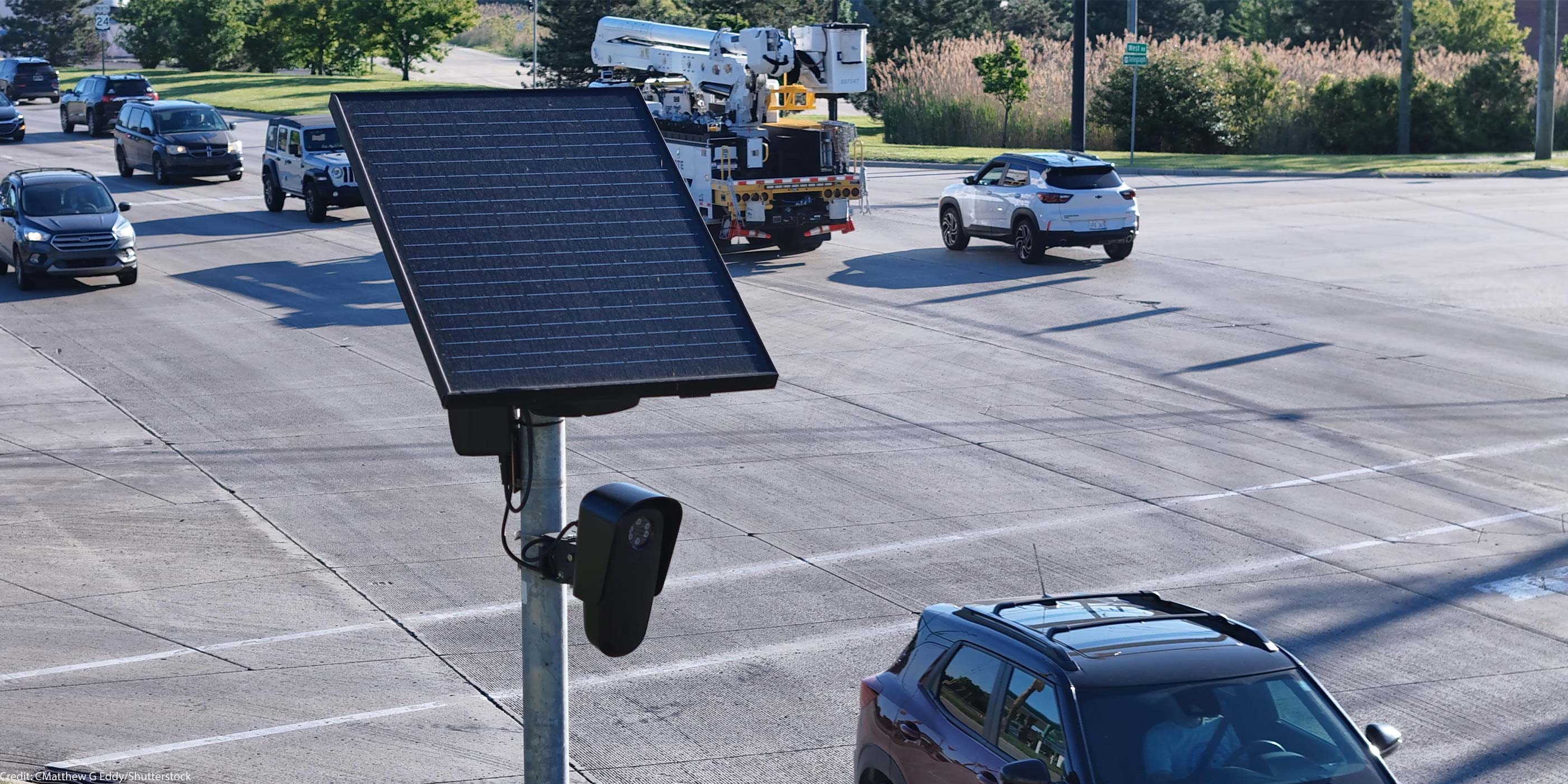
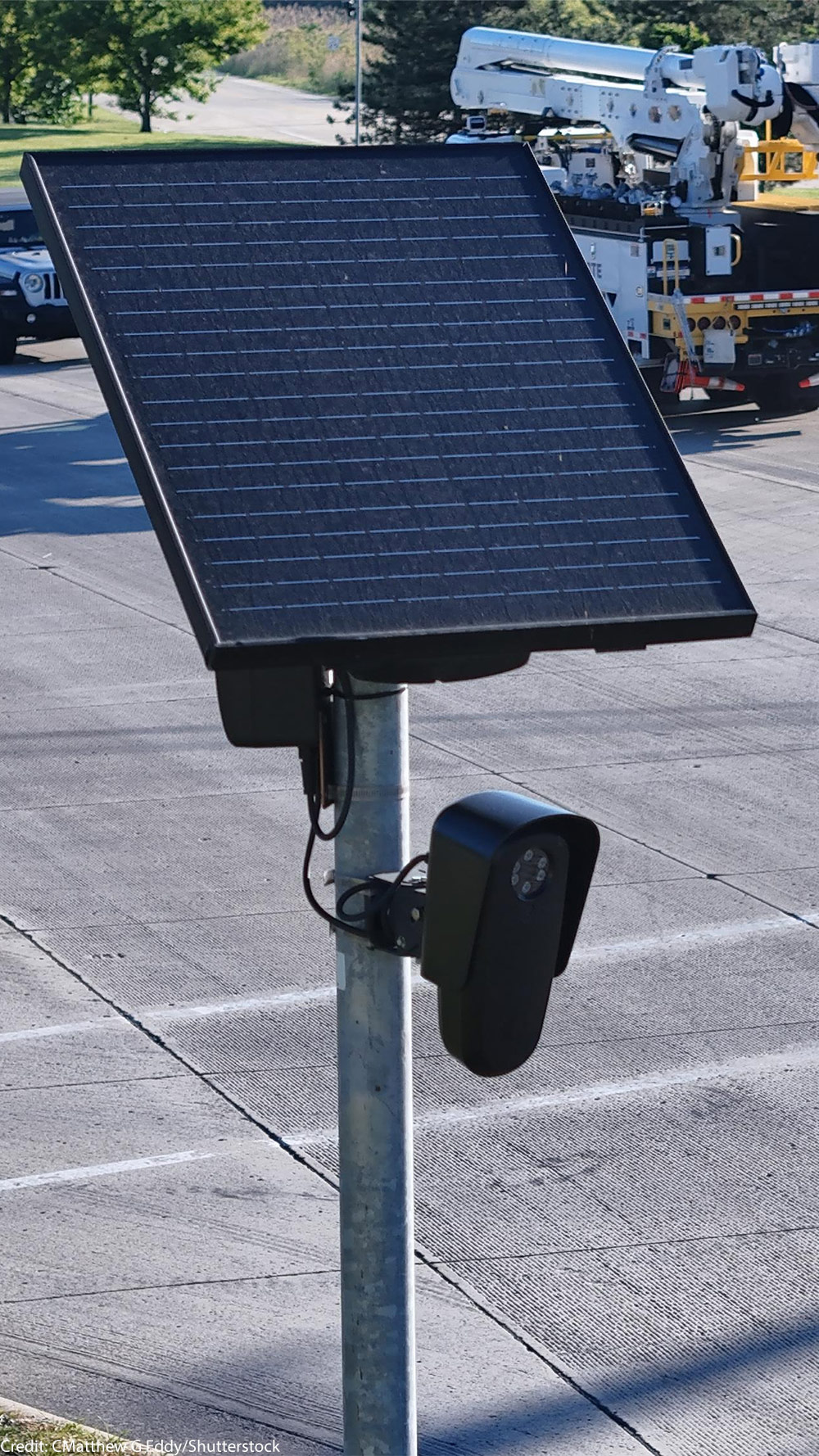
During a city council meeting in a suburb of Wisconsin in April, the city of Oshkosh considered whether it should approve a contract to use automatic license plate readers (ALPR) from Flock Safety, a prominent company that provides ALPRs to law enforcement agencies across the country. During the meeting, one city council member asked Flock if the company鈥檚 ALPR system created heat maps that could reveal where a particular vehicle had driven over a period of time. Flock鈥檚 chief information security officer, who was in attendance, that Flock鈥檚 system did not 鈥溾�� through the tracking of their vehicles. At the end of that meeting, the Oshkosh City Council approved a contract with Flock. The very next morning, the city .
Later that day, the city council reconvened to discuss what it had learned. Confronting Flock, Oshkosh Deputy Mayor Joe Stephenson said 鈥淚 don't know how this body can govern if someone tells untruths, mistruths, exaggerated truths. I don't know how I can make a decision or discern what's right or what's wrong, or even the capabilities of this system if you lie to me.鈥�
鈥淪hame on them,鈥� Oshkosh Mayor Matt Mugerauer added. 鈥淎ll I'm saying is if you give bad information, then I just don't want to work with you.鈥�
Ultimately, the Oshkosh City Council its approval, thereby setting a record for the shortest time between a city approving and cancelling a Flock contract: one day.
Flock later that its ALPR system does indeed produce a 鈥渉eat map鈥� that shows where 鈥減oint-in-time images have been captured of a vehicle鈥� for up to an entire month. However, the company chose to respond to the revocation of its contract by attacking the City of Oshkosh and its city council, complaining that Flock had 鈥渘ot [been] afforded the opportunity鈥� to explain its lie after being caught. Flock also sought to trivialize its factually inaccurate statement by categorizing it as 鈥渙ne small misconception鈥� and referring to the dispute over the system鈥檚 heat map tracking feature as 鈥渁 minor nuance.鈥�
What happened in Oshkosh was not an isolated incident. Rather, it reflects a pattern of Flock regularly misleading or even lying about its business practices, safety record, commitment to privacy, and efforts to protect vulnerable populations. And as was the case in Oshkosh, Flock鈥檚 lies are not just directed at the general public; they often specifically target Flock鈥檚 potential government customers. The urgent takeaway for government officials and police departments is that they should be extremely hesitant to believe anything Flock鈥檚 tells them about its company, its products, or its commitment to safety and privacy.

Privacy & Technology
Fight Creepy ALPR Cameras
Privacy & Technology
Fight Creepy ALPR Cameras
Flock's Pattern of Lies
This is far from the first time Flock has misled the public and elected officials. The company has demonstrated a pattern of treating legitimate operational questions and concerns not as problems to be solved, but rather as mere public relations issues.
In Colorado, Loveland Police Chief Tim Doran raised concern that federal agents were accessing the town鈥檚 ALPR data. the chief that federal agencies no longer had access to Loveland鈥檚 license plate readers, and had their CEO reiterate to the press that federal data sharing was a non-issue because Flock had no federal contracts. After contradictory information later came to light, the company was forced to admit that it did, in fact, have contracts with U.S. Customs and Border Protection (CBP) and Homeland Security (DHS) for pilot projects that gave those agencies direct access to license data. 鈥淲e clearly communicated poorly,鈥� Flock鈥檚 CEO , acknowledging that Flock鈥檚 鈥減ublic statements inadvertently provided inaccurate information.鈥�
Last year, revealed that, even in the absence of federal contracts, cooperating police officers and departments were regularly sharing Flock ALPR data and search results with immigration agencies like U.S. Immigration and Customs Enforcement (ICE) and CBP. The company responded to the reports with a disingenuous entitled 鈥淒oes Flock Share Data With ICE? No. Flock Does Not Work With ICE.鈥� In its blog, the company pushed back by asserting that 鈥淚CE does not have direct access to Flock cameras, systems, or data鈥� and that license data is 鈥渙wned and controlled by the customer.鈥�
Flock knew that, despite not being a customer, ICE had indirect access to Flock鈥檚 data and system through the company鈥檚 state and local law enforcement customers. The issue was never about having direct access to Flock鈥檚 data, it was about having any access to the data. But rather than address these data security and control issues on their merits, Flock released a misleading blog which reads as an attempt to confuse the public and create a false sense of security among its potential government customers. Ultimately, Flock was forced to accept that its denials were simply not credible. The CEO admitted Flock was used for immigration enforcement but argued that such matters were .
In May 2025, the press that Flock鈥檚 ALPR system had been used by law enforcement in at least one state, Texas, to track down a person seeking abortion care in another state, Illinois. Flock sought to assuage concerns about its system being used for cross-state abortion enforcement by unveiling 鈥淣ew Product Solutions to Strengthen Compliance鈥� led by its 鈥淧roactive Search Term Tool.鈥� In describing this new tool, Flock wrote:
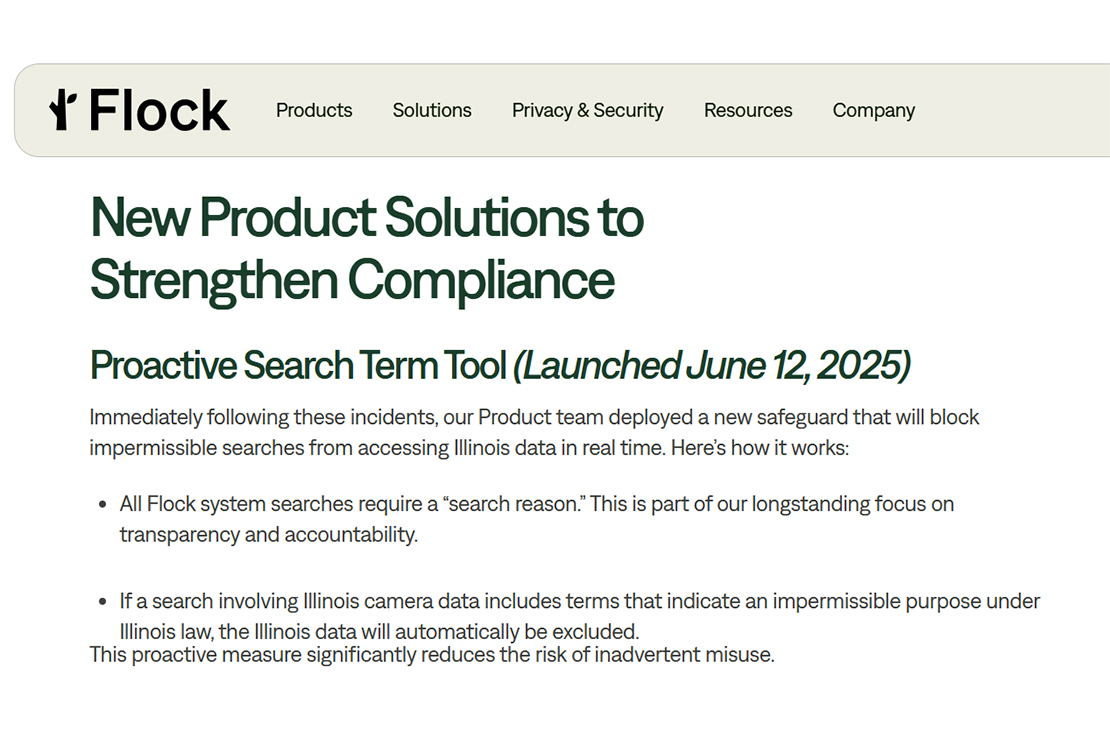
While Flock claimed its new oversight tool would 鈥渟ignificantly鈥� reduce the risk of improper uses like abortion enforcement, in reality the tool doesn鈥檛 work. As an investigation by our colleagues at the 红杏视频 of Massachusetts , Flock network audits showed police frequently enter vague terms like 鈥渋nvestigation鈥� or 鈥渟usp鈥� instead of information about the substance of the investigation into the search reason field. In September 2025 alone, a local Oregon police department was after entering 鈥渋nvestigation鈥� into the search reason field 111 times and 鈥渉ehehe鈥� into the field on 20 occasions, which demonstrates how easy it is to search Flock鈥檚 system while avoiding security-triggering words like 鈥渁bortion.鈥� Flock certainly would have known, if it conducted even a rudimentary test of its system, that the search field鈥檚 protections were extremely simple to circumvent. Nevertheless, Flock鈥檚 financial interests appear to have been better served by the company misrepresenting the efficacy of its security features to the public and its potential government customers.
Flock Even Lies 红杏视频 Partnering with the 红杏视频
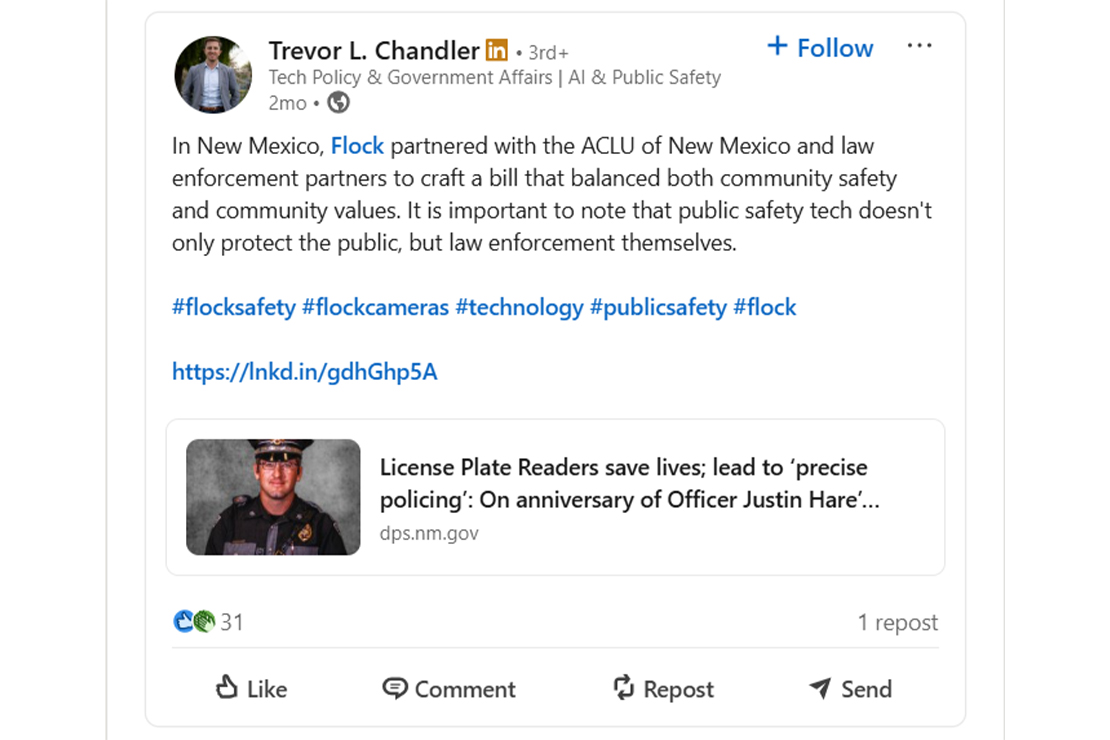
Flock has even made false claims to the public and elected officials about working with the 红杏视频. Earlier this year, after the 红杏视频 of New Mexico and Flock supported the same state-level ALPR legislation 鈥� albeit for very different reasons 鈥� Flock鈥檚 Senior Director of Public Affairs took to social media to claim that Flock partnered with the 红杏视频 of New Mexico to craft the bill and pass it.
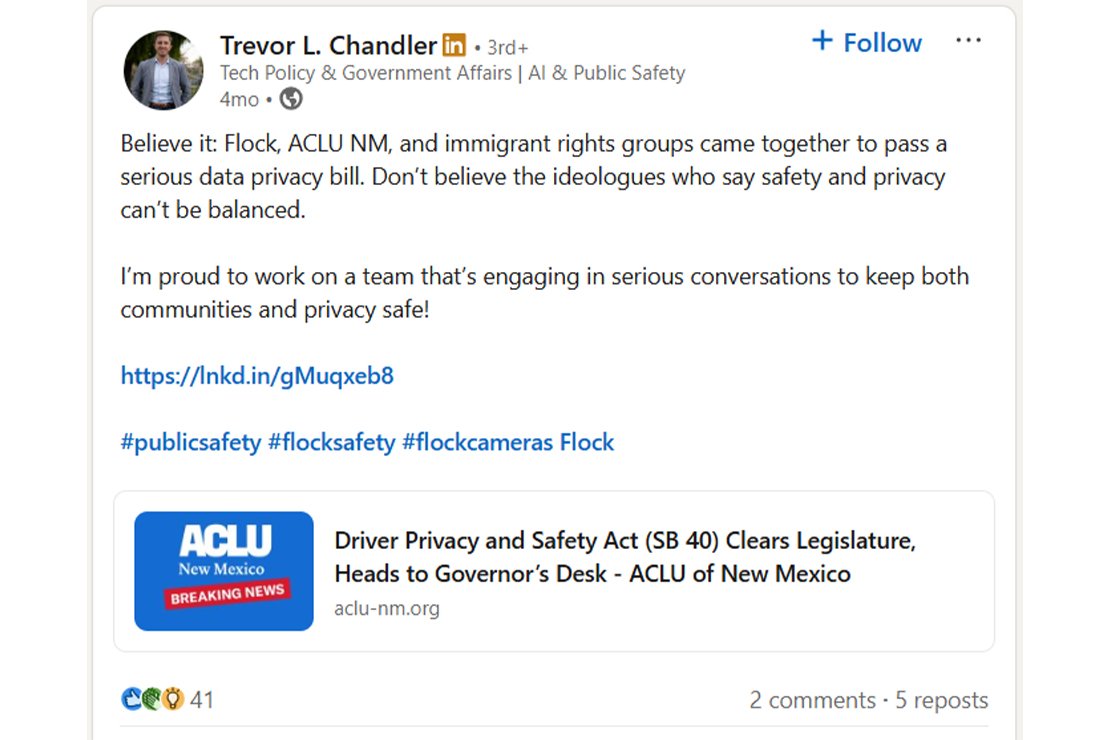
This was not the first time the 红杏视频 has caught Flock falsely claiming to have worked with us. During an Urbana, Illinois City Council in 2021, the company told councilmembers 23 minutes into the discussion that 鈥淔lock has worked with groups like the 红杏视频 to design an ALPR system that takes considerations they have into account.鈥�
To be clear, neither the 红杏视频 nor any of our affiliates have ever partnered with Flock Safety or worked with them to design any ALPR system. As an organization that has spent 106 years earning our good name and reputation, we can confidently advise Flock that lying to the public and elected officials about your work and your relationships is not how you get there.
Ultimately, reputable governments should not do business with disreputable companies. While governments should think long and hard about not using ALPRs, if local governments insist on doing so, at a bare minimum, they should adopt strong guardrails governing future ALPR use 鈥� including strictly limiting data retention, data sharing, and what crimes they can be used to enforce. And, of course, they should refuse to partner with any company that regularly misleads the public, elected officials, and even its own customers.
Related Issues
Related Content
-
News & CommentaryAug 2026

Privacy & Technology
Criminal Law Reform
Another Problem With Ai-assisted Police Reports: Companies Can Have Incentives To Distort Their Content. Explore News & Commentary.Another Problem With AI-Assisted Police Reports: Companies Can Have Incentives to Distort Their Content
Police Companies Could Train Their AI to Hide Use of Their Products or Make Them Look Good -
News & CommentaryAug 2026

Privacy & Technology
Beware Of Other License Plate Surveillance Companies Besides Flock. Explore News & Commentary.Beware of Other License Plate Surveillance Companies Besides Flock
Flock deserves the heat it鈥檚 getting, but switching to another provider won鈥檛 necessarily improve anything -
News & CommentaryAug 2026

Privacy & Technology
Despite 'new' Updates, Flock's Creepy Cameras Remain Major Civil Liberties Threat. Explore News & Commentary.Despite 'New' Updates, Flock's Creepy Cameras Remain Major Civil Liberties Threat
In response to Flock鈥檚 announcement of operational changes, the 红杏视频 breaks down why many fall short. -
Press ReleaseAug 2026

Privacy & Technology
National Security
As Public Opposition To Flock Grows, Aclu Responds To Surveillance Company鈥檚 鈥渘ew鈥� Updates. Explore Press Release.As Public Opposition to Flock Grows, 红杏视频 Responds to Surveillance Company鈥檚 鈥淣ew鈥� Updates
NEW YORK 鈥� Amid nationwide outcry against its automatic license plate readers, Flock Safety announced today that it will reduce its standard data retention policy and allegedly provide more control over local data searches, among other changes. However, according to 红杏视频鈥檚 new analysis, many of the proposed changes seem to be a thinly veiled PR attempt to counter communities鈥� genuine privacy concerns with its mass surveillance system with largely hollow security promises, rather than an earnest effort to address them. While the 红杏视频 acknowledges one potentially positive development, most of the proposed changes stand little chance of making a positive difference for civil liberties. 鈥淭ransforming an exceptionally dangerous mass surveillance system into one that is fully protective of civil rights and civil liberties is a difficult, if not impossible task. That is even more the case with a company like Flock, whose nearly $1 billion in venture capitalist funding has locked it into an operational model that seeks to trade our privacy for massive profits,鈥� said Chad Marlow, senior policy counsel at 红杏视频. 鈥淕iven that Flock鈥檚 latest announcement still appears more focused on addressing a PR problem than the significant privacy and other harms its products create, we will continue to analyze the company鈥檚 proposals fairly and honestly. We just won鈥檛 be holding our breath.鈥� Flock operates more than 120,000 automatic license plate readers in at least 6,000 cities across the country, raising serious concerns around mass surveillance, data privacy, and how police and the government can use this data to go after immigrants, protestors, and others. Just this week, the Institute for Justice published a database with more than 100 incidents of ALPR abuse, including romantic stalking, wrongful stops and detentions, non-law enforcement use, and other types of misconduct. One of the changes announced is that Flock will decrease its standard data retention option to one week from 30 days. This seems positive at first blush, but as the 红杏视频鈥檚 breakdown explains, the devil will be in the details. For example, an exception to the data retention policy is something called 鈥淓vidence Mode, which is 鈥渨hen a search is tied to a case number, that data is preserved instead of aging out after 7 days.鈥� As the 红杏视频 notes, 鈥淚f 鈥楨vidence Mode鈥� only retains hit result data that police determine may be evidence in an active investigation of a specific case, then the change may be a positive one. But if Evidence Mode triggers the retention of any ALPR data that is searched, then the new mode could indefinitely retain all the ALPR data Flock collects and shares nationally.鈥� Another 鈥渃hange鈥� the company is implementing is that local police will be able to decide what types of offenses other Flock customers can search their data for. The 红杏视频 contends that this is not new. Flock has attempted this before, and the security measure failed because police were easily able to circumvent the system鈥檚 requirement that they input the purpose of their search. Finally, Flock announced that in response to the reports of police abuse, they will now require reasons for a search, and that they plan to universally roll out its audit assistance tool to detect police misuse. Flock鈥檚 announcement fails to note how easily users have circumvented 鈥渟earch reason鈥� security measures in the past or how its new policy improves the quality of the feature. And while providing 鈥淎udit Assistance鈥� to all departments makes sense, the 红杏视频 notes that there is no evidence that the tool works consistently to address what the Washington Post observed is a growing pattern of police officers turning Flock into a personal stalking tool. To determine the efficacy of this tool, Flock needs to have it analyzed by an independent evaluator. Until then, the 红杏视频 says, 鈥渨e don鈥檛 know if the tool is a real security measure or just window dressing.鈥� Dozens of communities across the country have successfully convinced their leaders to cancel Flock contracts, suspend their ALPR programs, or deactivate the cameras, with many more cities considering new legislation to rein in this mass warrantless surveillance tech. In June, the 红杏视频 launched its 鈥淕et the Flock Out鈥� campaign to bring together the litigation, advocacy, and legislative efforts of 红杏视频 affiliates in each state, show how communities across the country are fighting back against the spread of Flock and other license plate readers, and lay out how lawmakers at the local, state, and federal level can best protect our rights.