The Trump Administration Is Disappearing Immigrants and Asylum Seekers in Growing Third Country Removal Campaign
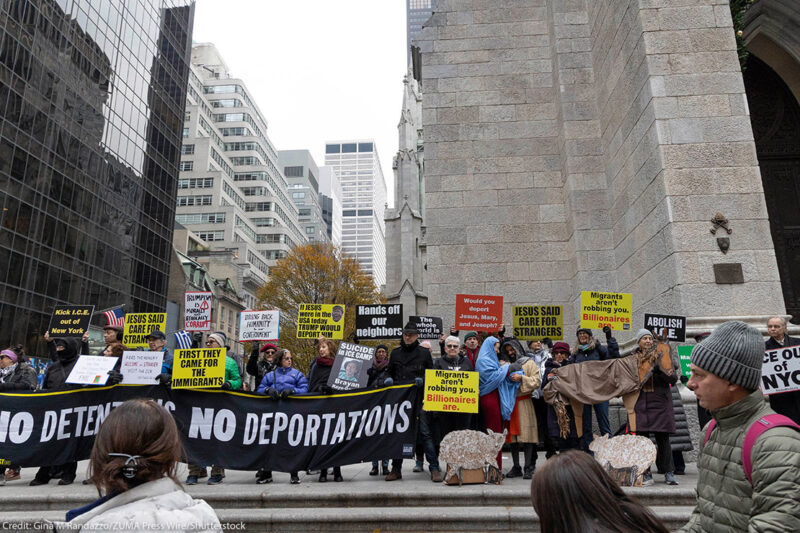
The Trump administration has deported over the last year and a half to countries they have no relationship with, where they may not speak the language, and where they generally have no legal status. Sometimes, it deports people to conflict zones or countries where they are likely to face persecution or even torture.
The Trump administration is spending tens of millions of dollars to fly people, shackled at times for , to “third countries� where they have no ties — even when they have won protection in U.S. immigration courts. The policies and agreements behind third country deportations are being negotiated behind closed doors, and some have never been made public.
On the one hand, what the U.S. government is really paying for is propaganda: The goal is to terrify immigrants into abandoning their cases and “self-deporting.� But at the same time, this administration is keeping its agreements, flight plans, and any information on who it has deported where and why as closely-held secrets. The secrecy is a strategy, and as we have seen with other regimes that participate in enforced disappearances, it is designed to hide these flights from court and public intervention, torment those on the flights, and terrify others waiting to find out if they will be next.
What Are Third Country Deportations?
The U.S. government is deporting people who cannot be returned to their countries of origin to third countries. In many cases, these are individuals who suffered torture or persecution in their countries of origin, and now the U.S. government is trying to find other places where they can be deported instead. This summer, the Trump administration accelerated its deportations of immigrants from Latin America, Central Asia, and the Middle East to a growing list of countries including Rwanda, Equatorial Guinea, and the Central African Republic that are being paid by the United States through obscure deals. Since June, for example, the U.S. has sent three deportation flights to the Central African Republic (CAR), deporting Afghans, Russians, Jordanians, Iranians and many others. And yet, the U.S. State Department CAR is too dangerous to visit, but if you do, make a will and leave a DNA sample to identify your body.
Immigrants' Rights
Immigrants' Rights
The U.S. government is spending at times $50 million per flight to deport people to third countries to them into giving up hope, abandoning their families, and self-deporting. Otherwise, they face what is effectively an to a country, even a continent, they’ve never seen. People deported to third countries have been held under house arrest or even in , with no pending criminal charges. There are now several reports of people deported to being assaulted and threatened by armed guards. They have no permanent legal status and often have no identification documents, money, or support once deported.
What makes this Machiavellian plan especially cruel is who it targets: people who won protection in U.S. courts after proving they were likely to be persecuted or tortured if deported back to the countries they fled. , for example, is a young Afghan whose father and siblings helped the U.S. military in Afghanistan. After his family was attacked by the Taliban, he tried to seek safety in the United States, where a judge found he would likely be persecuted if returned to Afghanistan. Rather than release him to his family in the United States, the government then deported him to CAR, a conflict zone where Russian mercenaries provide the “security� and Muslims are often of violence.
Khalil’s case isn’t the exception; it’s the Trump administration’s model. Over the last several months, the United States has deported an to CAR, a woman from Togo fleeing to Ghana, and a tortured by Boko Haram to Ghana. In both of the latter cases, Ghana then deported the individuals back to the countries they had protection from. We hear routinely about people who won protection on account of their and are now deported to countries like and where that status is criminalized. These are people who have already endured horrors and cannot safely return home. Our government is using their suffering as an example of what immigrants will face if they don’t self-deport while claiming that these countries have given diplomatic assurances that immigrants will be safe there — assurances that the government knows are, in fact, baseless.
The Secrecy Around Deportation Agreements
In January 2025, the United States had no third country deportation agreements. Today, the U.S. government has signed more than 35, with the exact number still unknown. There are now numerous cases of people deported to third countries under this scheme who have also then been deported onwards to the very countries they fled in what is known as chain refoulement, which is in violation of human rights law.
But while the government is deliberating broadcasting its general plans in order to coerce people into self-deporting, the Trump administration is also hiding specific details about its agreements, including who is being targeted for third country removal, to avoid scrutiny and public outcry.
In many cases, agreements between the United States and the receiving country are only publicly announced days before a deportation flight takes off. The agreement with the Democratic Republic of the Congo, for example, was in February 2026 but only made public in , shortly before the third country flight. Agreements with some repeat players like Mexico have never been made public; part of Ghana’s was just published this September, over a year after it was signed. This lack of transparency undercuts public and congressional oversight, fueling a system where people are deported in secret to horrific conditions with no accountability.
The flights are also a closely guarded secret, making it virtually impossible for detained individuals to find attorneys and contest their deportation to a place where they may face persecution or torture. The government’s secrecy appears to be a calculated attempt to rush people out of the country before court intervention and before the media or Congress can corroborate who is on the flights.

Immigrants' Rights
J.G.G. v. TRUMP
Immigrants' Rights
J.G.G. v. TRUMP
Last year, under the wartime Alien Enemies Act, the U.S. government illegally deported more than 100 people to El Salvador where they were detained and tortured at the infamous Terrorism Confinement Center, known as CECOT. During an emergency court hearing on March 15, 2025, where the ºìÐÓÊÓƵ sought a temporary restraining order, government counsel repeatedly told a federal court that counsel was not aware of any immediate plans to deport these men. In fact, two of the planes took off during the hearing. At the end of the hearing, the court the government to return the planes and not disembark them in El Salvador, whether they had taken off or not. While aware of the court order, the Trump administration ordered the flights to continue on to El Salvador and later claimed it could not bring the deported individuals back. The litigation continues, with hearings proceeding in September in federal court, to ensure due process for these individuals and to hold the government accountable for defying court orders.
Attorneys, Reporters, and Public Intentionally Left in the Dark
Hiding these flights was a deliberate strategy. To this day, the U.S. government continues to hide its third country deportation plans, particularly to places where people face danger. We routinely hear from attorneys that the government will not confirm where or when it might deport their clients, has even denied imminent plans to deport specific individuals who are already on the planes, and has allegedly lied to immigrants and their attorneys about the flight destination.
This secrecy is working for the government: It means that people cannot get lawyers in time, and reporters cannot obtain any official information about these deportation flights until the planes land. It means people cannot prepare for or challenge their deportation — and the public doesn’t know what has happened until it is too late. We may never know the full scope of what the United States is offering countries in exchange for taking our neighbors, and we may never get a full accounting of who has been disappeared. But what we are learning every week is that the dangers people face when deported, at taxpayer expense, are predictable, escalating, and intentionally cruel.
Related Issues
Related Content
-
Press ReleaseSep 2026

Immigrants' Rights
Parties File Joint Request To Dismiss Supreme Court Immigration Detention Case. Explore Press Release.Parties File Joint Request to Dismiss Supreme Court Immigration Detention Case
WASHINGTON — Today, both parties in Genalo v. G.M. filed a joint stipulation asking the U.S. Supreme Court to dismiss the case as moot following a pardon granted by New York Governor Hochul that eliminated the basis for Mr. G.M.’s deportation and detention. At the request of both sides, the Supreme Court dismissed the case, thereby cancelling upcoming arguments. The Second Circuit ruling requiring due process protections for prolonged detention will remain in place. Mr. G.M. is a lawful permanent resident who was held in ICE detention for 21 months without a bond hearing. His now-moot case challenged his prolonged immigration detention without meaningful due process. The ºìÐÓÊÓƵ, New York Civil Liberties Union, MacArthur Justice Center, and Hecker Fink LLP are co-counsel in this case. “This is a great outcome for our client who no longer faces the threat of deportation and future immigration detention,â€� said Cecillia Wang, national legal director of the ºìÐÓÊÓƵ. “The Second Circuit reached the correct decision in recognizing that prolonged immigration detention cannot continue without due process, and that decision will remain in place. We will continue to defend our Constitution’s limits on immigration detention and will keep up the fight against Trump administration’s extreme, unprecedented, and lawless positions.â€� "We are heartened that our client will not be separated from his family," said Amy Belsher, supervising attorney at the New York Civil Liberties Union. "The Second Circuit made abundantly clear that immigrants are entitled to due process, and we're gratified that their ruling will protect all those in the Second Circuit from prolonged detention." "Mr. G.M. spent 21 months locked away by ICE, separated from his family and community, without any consideration of whether he actually posed a danger or a flight risk. The Second Circuit saw that for what it was: a violation of due process," said Amit Jain, Counsel for the Supreme Court and Appellate Program at the MacArthur Justice Center. "This is a victory for Mr. G.M., and we will continue to fight alongside anyone, regardless of immigration status, who experiences such grave violations of due process." The administration’s position in Genalo v. G.M. drew cross-ideological opposition with 11 amicus briefs filed in total, including from former Republican senior government officials, members of Congress, and a former federal judge. In an amicus brief supporting G.M., they wrote that in their prior government roles they had “never asserted, nor ever heard the Government argue to this Court,â€� that a noncitizen detained under this law has no fundamental liberty interest. Although Genalo v. G.M will no longer proceed before the Supreme Court, the Trump administration’s efforts to expand mandatory detention and deny bond hearings to people who are immigrants, including longtime residents with deep ties to their families and communities, continues. Similar cases could make their way to the Supreme Court and will be met with forceful defense of due process. The joint stipulation is available here. -
Press ReleaseSep 2026
Immigrants' Rights
Federal Appeals Court Rules Against Trump Mandatory Detention Policy. Explore Press Release.Federal Appeals Court Rules Against Trump Mandatory Detention Policy
RICHMOND, Va.— Another federal appeals court has rejected the Trump administration’s new policy subjecting millions of immigrants to mandatory detention without access to bond hearings. The Fourth Circuit is now the ninth federal appeals courts to find the policy unlawful, along with hundreds of district courts. The ruling arose from habeas corpus petitions filed on behalf of Oscar Lopez Garcia and Juan Jose Rivera by their respective immigration counsel, Benach Pitney Reilly LLP and Ceartas Solutions. The ºìÐÓÊÓƵ, the ºìÐÓÊÓƵ of Virginia, and Murray Osorio PLLC joined the legal team representing petitioners in the government’s consolidated appeal. The case is Lopez Garcia v. Guadian. Last year, the Trump administration adopted a new radical reinterpretation of longstanding immigration laws and declared that anyone who entered the country without inspection must be detained without access to bond. For decades prior, people in removal proceedings who were detained by the government have generally had the right to seek release by an immigration judge. Among those who have been affected by the administration’s radical reinterpretation are people eligible for legal status, even those with long-pending immigration applications who have been waiting years due to administrative backlogs. The following is reaction to today’s ruling: “The courts have resoundingly rejected the administration’s cruel policy and its blatant disrespect for the rule of law,â€� said My Khanh Ngo, senior staff attorney with the ºìÐÓÊÓƵ’s Immigrants’ Rights Project. “We are thrilled for our clients and their families.â€� “The government cannot rewrite immigration law to serve this administration's anti-immigrant agenda by detaining people en masse, and today’s ruling again makes that crystal clear,â€� said Sophia Gregg, senior immigrants’ rights attorney with the ºìÐÓÊÓƵ of Virginia. “The Fourth Circuit’s decision is an important victory for both Virginians and for our civil rights and civil liberties nationwide.â€� “The Court has it right: ‘Mass detention of marginalized individuals without due process harkens back to some of the darkest moments in our country’s history... Those shameful and abhorrent past detentions were limited in scope in comparison to’ what the Government asked for in this case. We are thrilled that the Court declined to expand mandatory detention to millions of people,â€� said Sarah Pitney, partner at Benach Pitney Reilly LLP and counsel for Mr. Lopez Garcia. “I have seen over and over again the devastating impact that the detention of a mother or father has on their children, many of whom are U.S. citizens,â€� said Sarnata Reynolds, founding attorney at Ceartas Solutions. “Today’s decision restores a basic safeguard: the government cannot imprison members of our communities throughout their immigration cases without giving them a meaningful chance to seek release.â€� The ruling is here. -
Press ReleaseSep 2026
Immigrants' Rights
Legal Groups That Secured Supreme Court Birthright Victory File New Motions Responding To Latest Executive Order. Explore Press Release.Legal Groups That Secured Supreme Court Birthright Victory File New Motions Responding to Latest Executive Order
CONCORD, N.H. — Legal groups that secured a June Supreme Court victory in Trump v. Barbara on behalf of babies who would have been denied citizenship under a failed Trump executive order filed new motions in the case today. The latest filings aim to protect people subjected to the president’s new executive order, which was signed in early August and again targets birthright citizenship. The ºìÐÓÊÓƵ, ºìÐÓÊÓƵ of New Hampshire, ºìÐÓÊÓƵ of Maine, ºìÐÓÊÓƵ of Massachusetts, Legal Defense Fund, Asian Law Caucus, and Democracy Defenders Fund successfully argued the Barbara case. On Aug. 11, they asked a New Hampshire federal court, where the Barbara lawsuit was first filed, to make it unquestionably clear that the citizenship of babies covered by that class-action lawsuit is protected despite the new executive order. In their new filings, they are asking the court to certify a new class given the latest executive order. In its June ruling, the Supreme Court confirmed that the Constitution’s Citizenship Clause puts “the question of citizenship ‘once and forever [to] rest.’â€� The following are comments on today’s filings: “The Trump administration continues to threaten birthright citizenship, even after its definitive loss at the Supreme Court,â€� said Cody Wofsy, deputy director of the ºìÐÓÊÓƵ’s Immigrants’ Rights Project and lead counsel. “We will never stop fighting to protect this fundamental constitutional principle.â€� “The Constitution and the Supreme Court were exceedingly clear: Citizenship is a constitutional right given to all children born in America and any attempt to restrict that right is illegal,â€� said Amia Trigg, deputy director of litigation at the Legal Defense Fund. “Regardless of race, color, or ancestry, birthright citizenship protects children that are born here. And the president's latest attempt to rescind that protection is just another example of an egregious overreach by the executive branch.â€� “Trump’s executive order on birthright citizenship is yet another attack on the rule of law,â€� said Aarti Kohli, executive director of the Asian Law Caucus. “The Trump administration is ignoring the needs of everyday Americans to target immigrant communities. We’re fighting in court to ensure all our rights are protected and stop this administration’s unlawful attempt to ignore the Constitution and Supreme Court.â€� “Our latest motions demand accountability for Trump’s dangerous policies,â€� said Tianna Mays, legal director at Democracy Defenders Fund. “This administration cannot unlawfully strip the rights of babies and ignore the Constitution in order to achieve its political goals. We won’t let that stand, and we’ll continue our fight in court.â€� SangYeob Kim, director of the ºìÐÓÊÓƵ-NH Immigrants’ Rights Project, said, “Birthright citizenship is the law of the land — as it has been for more than 150 years and as the U.S. Supreme Court affirmed once again just a few months ago. Cruel attacks on this core constitutional right must not be allowed to stand.â€� “The president may keep signing unlawful executive orders, but the Supreme Court could not have been more clear when it ruled that neither the president nor Congress can end birthright citizenship,â€� said ºìÐÓÊÓƵ of Maine Executive Director Molly Curren Rowles. “We’ll continue defending the Constitution and the core principles reflected in the 14th Amendment: that with very few clear exceptions, every baby born on U.S. soil is a U.S. citizen.â€� “Despite a clear ruling from the U.S. Supreme Court just weeks ago, the Trump administration is still trying to deprive babies born in the United States of their constitutional rights,â€� said Carol Rose, executive director at the ºìÐÓÊÓƵ of Massachusetts. “We cannot tolerate this brazen act of lawlessness. No matter how many times President Trump tries to deny it, birthright citizenship is here to stay.â€� Read the motions here. -
Press ReleaseSep 2026
Criminal Law Reform
Immigrants' Rights
Aclu Urges Court To Allow Lawsuit Challenging Violent Idaho Immigration Raid To Proceed. Explore Press Release.ºìÐÓÊÓƵ Urges Court to Allow Lawsuit Challenging Violent Idaho Immigration Raid to Proceed
BOISE – The ºìÐÓÊÓƵ, the ºìÐÓÊÓƵ of Idaho, Stoel Rives, and Cooley LLP filed an opposition brief today on behalf of their clients, urging a federal court to allow a lawsuit challenging the violent mass detention of hundreds of Latino people for an immigration dragnet at a family horse-racing event in Wilder, Idaho to proceed. The lawsuit, Rodriguez et al. v. Porter et al., was filed earlier this year on behalf of three Latino families and a proposed class of people who were at La Catedral Arena on October 19, 2025, when more than 200 federal, state, and local law enforcement officers descended on an otherwise peaceful family event. Law enforcement arrived in armored trucks and a helicopter with flashbang grenades and guns drawn and detained approximately 400 spectators – including U.S. citizens and children – for four hours of detention in inhumane conditions before subjecting everyone to suspicionless immigration interrogations. In their motions to dismiss, defendants continue to characterize the operation as a routine execution of warrants for five people accused of non-violent unlicensed gambling. The ºìÐÓÊÓƵ’s brief filed today makes clear that hundreds of heavily-armed officers detaining hundreds of people with no connection to the gambling allegations – and prolonging their detention to investigate everyone's immigration status – was anything but routine. “Our clients are still living with the physical and emotional scars from that day, and yet the defendants continue to try to rewrite what happened,â€� said Allison Frankel, senior staff attorney at the ºìÐÓÊÓƵ’s Criminal Law Reform Project. “Warrants for five people accused of unlicensed gambling do not give police a blank check to round up hundreds of people, hold families at gunpoint, or target people based on their perceived ethnicity. We know what happened at La Catedral, and we’re going to keep fighting to hold those responsible accountable and make clear that law enforcement is not above the law.â€� Juana Rodriguez, one of the lead plaintiffs, is a U.S. citizen who was at the racetrack with her 3-year-old son. After being violently rounded up with hundreds of other families, Rodriguez was placed in zip ties and detained for several hours without food or water. Law enforcement instructed her toddler to hold onto her pocket, which they had turned inside out, while Rodriguez remained zip tied and unable to comfort her son as he cried out for water. "The cruelty that occurred in Wilder is a tragic example of a government operating with reckless violence and unrestricted power," said Paul Carlos Southwick, legal director for the ºìÐÓÊÓƵ of Idaho. "The human cost of this operation is unacceptable. Law enforcement must answer for the large-scale civil rights abuses that took place so we can ensure this never happens again.â€� The lawsuit alleges that federal, state and local law enforcement used the criminal warrants as a cover to conduct a sweeping immigration dragnet targeting an event where they knew the attendees would be predominantly Latino. The complaint centrally claims that these federal, state and local actors conspired to deprive those detained of their Fourth Amendment rights against unreasonable detentions, and their right to equal protection regardless of ethnicity. The complaint is brought under laws created after the Civil War to prevent racialized government violence. The conspiracy claims provide a path to hold federal actors accountable for civil rights violations. The brief is available here: /cases/rodriguez-et-al-v-porter-et-al?document=Plaintiffs-Opposition-to-Defendants-Motions-to-Dismiss