ICE is Rapidly Expanding Dangerous 287(g) Agreements with Local Police
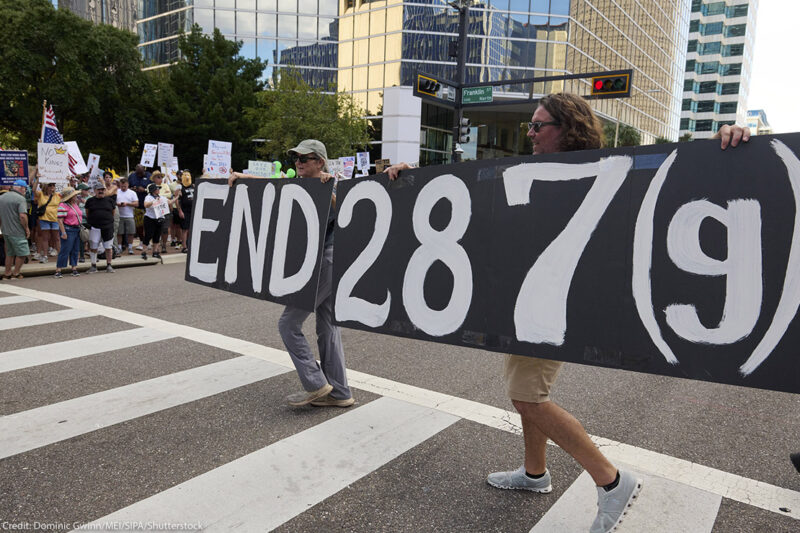
Masked, lawless federal agents have become a symbol of the Trump administration’s violent drive to deport millions of people. But across the country, thousands of state and local police are increasingly mimicking these abusive federal agents, blending into their operations and intensifying fear in their own communities.
At least 77.2 million people — 32 percent of the country — now live in a county with a local law enforcement agency that has enlisted in the 287(g) program. The program is a set of partnerships between U.S. Immigration and Customs Enforcement (ICE) and state and local agencies that effectively turns local police into ICE agents. Under Trump, the number of 287(g)-participating agencies has expanded rapidly. In September 2025, the Department of Homeland Security (DHS) said it had trained, or was in the process of training, more than under the program’s abuse-prone, street-level enforcement model. This is all while ICE has drastically reduced training requirements for officers overall and inadequately expanded its capacity to supervise them.
The ºìÐÓÊÓƵ’s new report, "Deputized for Disaster," examines the 287(g) program and how the second Trump administration has used it to draw state and local police away from the needs of communities, and into a national deportation force that acts as though it answers only to the president. Here are the key takeaways from our report.
The 287(g) program draws state and local police away from the needs of communities
Prior research by the ºìÐÓÊÓƵ documented how the 287(g) program has fueled racial profiling, civil rights violations, and violence throughout its history. It has opened up law enforcement agencies to the risk of lawsuits that have cost . Under the second Trump administration, the 287(g) program is only growing more dangerous each day. "Deputized for Disaster" shows how the Trump administration has used the 287(g) program to supersize its deportation force. We found that the administration is using state and local police to conduct “show me your papersâ€� dragnet-style enforcement, with the goals of more deportations and driving millions more to self-deport.
Countless vulnerable people have been caught in this dragnet. In Florida, local police pulled over a 22-year-old cancer patient and assisted Border Patrol in arresting her , who was driving her home from the hospital. Florida police have also reportedly invited Border Patrol to run immigration checks on and set up immigration checkpoints on the only highway into the , a major tourist destination, leading to more than 300 immigration arrests.

Immigrants' Rights
Immigrants' Rights
Immigrants' Rights
Immigrants' Rights
As the administration concentrates executive power into its deportation force, it blurs the lines between federal and state and local law enforcement. This is a recipe for further civil rights violations: as local police follow the cues of federal agents, abusive tactics spread, and responsibility becomes unclear. For example, an estimated 200 law enforcement agents from federal, state, and local agencies descended on a in Idaho where families had gathered, arresting more than 100 people and zip-tying children and adults, including U.S. citizens. In the aftermath, local police denied their involvement, and those detained and separated from their children found it difficult to pinpoint exactly who was responsible.
The 287(g) program also causes officers to neglect critical public safety needs, as they redeploy their already-limited time and resources to federal immigration enforcement. And it changes the way communities live — people avoid going to work, taking children to school, and interacting with police or the government entirely, even when they are the of crimes .
The Trump administration is concentrating its power through 287(g) agreements with more than just law enforcement
While the 287(g) program has already resulted in abuse, the administration has set in motion dangerous plans. These include the use of 287(g) agreements on which has caused some students to leave college, and the use of state National Guard for immigration enforcement. This undermines public trust in the National Guard’s response to legitimate emergencies, threatens the crucial separation of military and civilian roles integral for democracy, and puts troops in legal and ethical jeopardy.
Increasingly, ICE is enlisting partners from new agencies, diverting them from their core missions and creating even greater fear among communities. The , charged with preventing and investigating fires, has joined the program, along with agencies like Louisiana Wildlife & Fisheries and the Florida Department of Environmental Protection, which regulate the environment and agriculture.
This is all part of the Trump administration’s plan to concentrate government power — federal, state, and local — to fuel his deportation machine. He is sowing distrust between communities and law enforcement, threatening public safety, and driving people into hiding.
Local police should serve their communities; states and cities must say no to the 287(g) program
People should be safe to live in their communities — without fear of local police sworn to protect them, now operating as immigration agents. In 2026 and the waning months of 2025, and all enacted legislation to ban 287(g) agreements, joining six other states who have long prohibited participation in the program.
Where banning 287(g) is not possible, states and cities must limit their officers’ involvement, consider the risks of participating, and strengthen oversight of the program. State and local law enforcement should not be complicit in widespread, flagrant abuse. Instead, they should stand up for their communities and refuse to take part in the Trump administration’s growing deportation machine.
Related Issues
Related Content
-
U.S. Supreme CourtAug 2026
Immigrants' Rights
Genalo V. G.m.. Explore Case.Genalo v. G.M.
In 2024, the U.S. Court of Appeals for the Second Circuit ruled that Keisy G.M., a lawful permanent resident who had been subjected to mandatory detention for 21 months, could not be detained any longer without a hearing on whether he poses a flight risk or danger. That decision was consistent with the vast majority of federal court rulings on the government’s practice of detaining people for prolonged periods of time without any individual hearings. The Trump administration appealed the ruling in January 2026 and on June 15 the Supreme Court agreed to hear the case, setting oral argument for Oct. 13, 2026. The Trump administration is taking a radical position the government has not taken in the 30 years since this mandatory detention statute, 8 U.S.C. 1226(c), was enacted by Congress. It says immigrants like Mr. G.M. do not have a protected liberty interest in not being locked up without a hearing — at a time when the administration is pushing hard to detain and deport as many immigrants as possible, often locking people away in inhumane ICE detention centers, where deaths are already at record levels. On the government’s theory, it can lock up people under this mandatory detention statute for months, years, or even decades, without a hearing — as long as the removal case is still ongoing. The ºìÐÓÊÓƵ, New York Civil Liberties Union, MacArthur Justice Center, and Hecker Fink LLP are co-counsel. The groups argue the federal appeals court ruling is correct, and that the Constitution protects all of us, regardless of immigration status, from being locked away without due process. -
Press ReleaseAug 2026

Immigrants' Rights
Another Federal Appeals Court Rejects Trump Mandatory Detention Policy . Explore Press Release.Another Federal Appeals Court Rejects Trump Mandatory Detention PolicyÂ
PHILADEPHIA — Another federal appeals court has rejected the Trump administration’s new policy subjecting millions of immigrants to mandatory detention without access to bond hearings. Today’s ruling from the U.S. Court of Appeals for the Third Circuit stems from a lawsuit brought by the ºìÐÓÊÓƵ, ºìÐÓÊÓƵ of Pennsylvania, ºìÐÓÊÓƵ of New Jersey, and the law firm of Palladino, Isbell & Casazza, LLC. The case is Buele Morocho v. Warden Philadelphia FDC. The Third Circuit decision joins similar rulings from seven other federal appeals courts and hundreds of district court judges in finding the policy unlawful. For decades, immigrants in removal proceedings who were detained by the government have generally had the right to seek release by an immigration judge. In mid-2025, the Trump administration suddenly adopted a new radical reinterpretation of the immigration laws and declared that anyone who entered without inspection must be detained without access to bond. Among those who were affected were people eligible for legal status, even those with long-pending immigration applications who have been waiting years due to administrative backlogs. The following is reaction to today’s ruling: “The courts have repeatedly and resoundingly rejected the Trump administration’s radical reinterpretation of our country’s detention laws. This ruling is another critical victory against the administration’s cruelty and disrespect for the rule of law. We are thrilled for our clients and their families,â€� said Michael Tan, deputy director of the ºìÐÓÊÓƵ’s Immigrants’ Rights Project. “Even before the Trump administration began its campaign to detain every person it could round up, immigration detention was a cruel and unnecessary practice,â€� said Vanessa Stine, senior staff attorney at the ºìÐÓÊÓƵ of Pennsylvania. “But denying bond hearings to the individuals ICE detains is an alarming trend that is blatantly at odds with the plain text of the statute and the Constitution’s guarantee of due process. We applaud today’s decision and look forward to continuing the fight to end the Trump administration’s dangerous and unconstitutional targeting of immigrant communities.â€� “This ruling underscores that this administration cannot make up its own rules in order to lock up huge numbers of people without a bond hearing,â€� said Farrin Anello, senior counsel for the ºìÐÓÊÓƵ of New Jersey. “We applaud the court’s careful and painstaking analysis of the statutes in question and its conclusion that the government must follow the plain language of the law and the Constitution in order to take away someone’s freedom. Today is a win for immigrants’ rights and the rule of law.â€� “Within the Third Circuit, this decision puts an end to a year-long campaign by the administration to indefinitely detain human beings without due process. We feel incredibly fortunate to have co-counseled with this legal team on this case," said Christopher M. Casazza, attorney with Palladino, Isbell & Casazza, LLC. The ruling is here. -
Press ReleaseAug 2026
Immigrants' Rights
Federal Appeals Court Upholds Rights Of Detained Noncitizens To Bond Hearings. Explore Press Release.Federal Appeals Court Upholds Rights of Detained Noncitizens to Bond Hearings
First Circuit is the seventh appellate court to reject Trump administration's novel application of immigration detention statutes A federal appeals court on Thursday upheld a ruling declaring that the Trump administration is unlawfully denying bond hearings to thousands of people arrested by U.S. Immigration and Customs Enforcement in New England. In 2025, the federal government abandoned its 29-year understanding of a 1996 law and announced that millions of noncitizens living in the United States would have no opportunity to ask for release on bond if detained by ICE. This new guidance defies decades of government practices, federal law, and fundamental due-process protections. It also exacerbates longstanding problems with immigration detention, including overcrowding, medical neglect, inadequate nutrition, and more. Last night, the First Circuit Court of Appeals upheld a District Court ruling finding the new policy unlawful, reasoning that the federal government’s interpretation violated the relevant statutory text and congressional intent. "This ruling affirms that the Trump administration cannot unilaterally rewrite federal statutes to suit its political agenda," said Adriana Lafaille, managing attorney at the ºìÐÓÊÓƵ of Massachusetts. "This is especially important for matters of fundamental fairness, like the ability to seek release from detention. The federal government must follow the law, provide bond hearings to class members, and allow those who pose no danger or flight risk to be released while immigration courts decide their cases." With Thursday’s ruling, seven appellate courts and hundreds of District Court judges have now issued rulings holding that the Trump administration’s new policy of subjecting noncitizens living in the country to categorical detention without a bond hearing is unlawful. “I am gratified that the First Circuit upheld the rule of law, affirming what we have known since 1996: Immigrants, regardless of how they entered our country, are entitled to bond hearings. I am in awe of our client's courage to fight for what is right, securing not only his freedom but that of hundreds of other immigrants in New England,â€� said Annelise Araujo, founding principal and owner at Annelise Araujo Law. “We are pleased that the court is vindicating the rights of immigrants unlawfully detained in Maine and throughout New England,â€� said ºìÐÓÊÓƵ of Maine Legal Director Carol Garvan. “The government’s cruel mandatory detention policy stripped people of the chance to seek their freedom while indefinitely separating them from their loved ones, communities, and jobs. The policy also upended decades of standard civil immigration procedures, violating the clear language of federal law. The court's order today is clear: no administration is above the law. The government cannot arrest and detain people indefinitely without providing them with a hearing in front of a judge.â€� The petitioner and class in Guerrero Orellano v. Monizare represented by the ºìÐÓÊÓƵ of Massachusetts, the ºìÐÓÊÓƵ, the ºìÐÓÊÓƵ of New Hampshire, the ºìÐÓÊÓƵ of Maine, Annelise Araujo Law, Foley Hoag, Anderson & Kreiger, and the Harvard Immigration and Refugee Clinic. BACKGROUND The original complaint in this case was filed in September 2025 on behalf of Jose Arnulfo Guerrero Orellana and a class of similarly situated individuals. In October, the court granted a preliminary injunction and ordered a bond hearing for Mr. Guerrero Orellana, who was later released on bond. Later that month, the court certified a class of people arrested by federal immigration officials inside the United States and held in New England detention facilities. In December, the court grantedpartial summary judgment and rejected the government’s novel and erroneous statutory interpretation. As disclosed in subsequent court filings, the government’s chief immigration judge later instructed her colleagues to ignore declaratory judgments like the one entered in this case. Immigration judges have continued to systematically deny bond hearings to people arrested by ICE within the United States who are alleged to have entered without inspection, no matter how long the person has been in the country. This policy violates the plain language of the federal detention statutes and denies fundamental due process rights to potentially millions of people. Read the opinion here. -
Press ReleaseAug 2026
Immigrants' Rights
Aclu Comment On Federal Appeals Court Ruling In Alien Enemies Act Challenge . Explore Press Release.ºìÐÓÊÓƵ Comment on Federal Appeals Court Ruling in Alien Enemies Act ChallengeÂ
NEW ORLEANS — The full Fifth Circuit Court of Appeals in New Orleans today dismissed W.M.M. v. Trump, a case challenging President Trump’s invocation of the Alien Enemies Act. The court ruled the case was moot because plaintiffs have since been removed under immigration laws, not the Alien Enemies Act. The court did not rule on the merits of the lawsuit. The ruling stems from a case filed by the ºìÐÓÊÓƵ and the ºìÐÓÊÓƵ of Texas challenging the president’s use of this centuries-old wartime act in peacetime. The Supreme Court previously blocked the Trump administration from using the Alien Enemies Act to remove Venezuelans who were being detained in northern Texas and told the Fifth Circuit to expedite the appeal, while keeping a stay in place. In September 2025, a three-judge panel of the Fifth Circuit rejected the administration’s assertion that the wartime authority’s invocation was lawful because an “invasion or a predatory incursion has occurred.â€� The Trump administration then sought a hearing before the full appeals court, which heard the case in January 2026. The ºìÐÓÊÓƵ has other legal challenges to the Alien Enemies Act ongoing throughout the country. The following is reaction to today’s Fifth Circuit ruling: “The Supreme Court's injunction barring use of the Alien Enemies Act remains in place, which is essential because there are still people at risk of being wrongly removed under the act without due process. The Fifth Circuit decision also doesn’t change the fact that courts have overwhelmingly held that the use of this wartime authority during peacetime is unlawful,â€� said ºìÐÓÊÓƵ attorney Lee Gelernt, who argued the case. The ruling is here.